Excerpted on 28 May 2020 from a blog published on 29 September 2019
DANGER FOR HIKERS AND CAMPERS IN RURAL VENTURA COUNTY AND LOS ANGELES COUNTY?
NEED FOR INTER-COUNTY LAW ENFORCEMENT LIAISONS AMONGST COUNTIES ADJACENT TO THE CITY OF LOS ANGELES
Dear Ones,
DANGER FOR HIKERS AND CAMPERS IN RURAL VENTURA COUNTY AND LOS ANGELES COUNTY?
In the last few years, I have clairly listened to several astral stories while exploring the byroads and hiking trails of Ventura County north of Ojai and of Los Angeles County north of Santa Clarita. What intuition very strongly tells me is that those of us who hike and camp in rural areas of Ventura County and Los Angeles Cunty are in danger of thefts from our parked vehicles (including theft of electronics, personal items, and tires); theft of the vehicles themselves; burglary of equipment from our tents; and apparently possible violent loss of our lives so that thieves may market our stolen goods and cars without being caught out.
I feel what intuition tells me is greatly increased danger in this regard may have to do with higher water costs for Ventura County and Los Angeles County rural residents, the need for food and firewood for their homes, and the need for feed and water for their livestock. It seems to me reasonable, if these crimes are occurring, to try to find out if local Ventura County and Los Angeles County residents have a hand in it.
NEED FOR INTER-COUNTY LAW ENFORCEMENT LIAISONS AMONGST COUNTIES ADJACENT TO THE CITY OF LOS ANGELES
It is possible that, because of increasing economic stresses in California, residents of small towns and of rural areas … including their law enforcement agencies … may be beginning to band together to protect themselves from outsiders, and to profit by occasional raids on tourists and visitors such as I describe above.
I ask that law enforcement for counties adjacent to the City of Los Angeles reach out, each to the other, so as to form as close bonds of cooperation and information exchange as possible. In that way, we can keep Southern California strong and safe for everyone.
In love, light and joy
This is Alice B. Clagett.
I Am of the Stars … and so are you!
The above concerns are derived from intuition and clair perception; they cannot be said to be factual in any regard unless facts are found that support the ‘astral intel’.
Excerpted from Link: “The Ghouls of Sere Vale,” an Astral Story by Alice B. Clagett, filmed on 28 August 2019; published on 29 September 2019; revised on 22 June 2020 … https://wp.me/p2Rkym-ejX ..
law enforcement, Ventura County, California, astral stories, Los Angeles, economy, travel in the United States, hiking, camping, crime, crime prevention, theft, burglary, vehicular theft, cities of Earth, countries of Earth, government, sedition, treason, common good, social unrest, community alerts,
Written and published on 28 December 2019
Previously titled: A Thought for the New Year
THE HUMAN HEART, ALIGNED WITH THAT OF GOD, UNVEILS GREAT MYSTERIES
Dear Ones,
I found a note in my hand in my well-worn copy of the book “How to Know God: The Yoga Aphorisms of Patanjali” and was inspired to write this message for my star kindred here on Earth. The occasion is New Years Day 2020 …
THE HUMAN HEART, ALIGNED WITH THAT OF GOD, UNVEILS GREAT MYSTERIES
It is the error of men to try to control the world … and the error of women to try to save it. In truth, there is no world beyond our sphere of influence … no world beyond us, against which we struggle in vain. Our realm of endeavor … our purpose of attaining human form … lies right within us.
May I master my wayward mind through contemplation of my heart, as Patanjali advises …
Citation: “How to Know God: The Yoga Aphorisms of Patanjali,” translated with a commentary by Swami Prabhavananda and Christopher Isherwood, copyright 1953, 1981 by The Vedanta Society of Southern California … See page 187; the chapter “III. Powers,” number 35, which states (to paraphrase) that it is through contemplation of the heart that we master our own minds.
May I learn to control, not the world … not the ways of power, nor the ephemeral billboard of worldly fame, nor the intricate Dark web of political intrigue … but rather to control myself. May seek to I save myself, through God’s grace.
May I humbly seek to align my heart with the Great Heart of God which, beating and pulsing through the pathways between the stars … those byways of the Angel Realm … informs and enlivens all beings everywhere … from the tiniest cosmic ray to the greatest star; from the humblest mineral form to the most sentient of beings; and in our earthly realm, from the poorest and most desperate of humankind to the popes and presidents of countries and of international conglomerates.
Who knows but what the well tuned heart might sing the song of God’s mighty Universe; and, taking Archangel Michael by the hand, traverse with him the farthest reaches of His great creation! So may each of us, I pray, walk with utmost reverence the great interstellar paths, and come to know, in the truest sense, that we humankind are children of the stars.
In love, light and joy
This is Alice B. Clagett.
I Am of the Stars … and so are you!
Then I read in an article written for CNET by Katie Teague and Kelsey Fogarty on 14 September 2021 that the IRS might take 6 months (rather than the usual 3 weeks) to process the tax returns of about 10% of its taxpayers. Here is an update on the state of as-yet-unprocessed returns for tax year 2021 and a similar warning for tax return delays for tax year 2022 … Link: “Your Tax Return Might Be Delayed This Year, the IRS Warns,” by Alicia Adamczyk, 13 January 2022, in Make It … https://www.cnbc.com/2022/01/13/irs-warns-there-will-be-delays-processing-2021-tax-returns-and-refunds.html ..
And finally, I read that the United States Post Office is cutting post office hours and lengthening delivery times in a new 10-year plan … Link: “USPS Chief Dejoy Cuts Post Office Hours, Lengthens Delivery Times in New 10-Year Plan,” by Jacob Bogage, 23 March 2021, in The Washington Post …https://www.washingtonpost.com/business/2021/03/22/usps-dejoy-plan/ ..
…
1. ECONOMIC STRESSORS THAT MAY LEAD TO DECENTRALIZATION OF THE UNITED STATES GOVERNMENT top
I have some thoughts on the state of the nation. Intuitively, I sense economic stressors that may gradually lead to our Federal government taking a lesser role in the governance of the United States, compared to the role of regional alliances of states.
Just to put this into perspective, this might be more of a Libertarian notion as a way of the ruling of the United States, still within the plan of our democracy, but rather different in emphasis from what we have known for a long time as the Democratic / Republican dichotomy.
All this time, Greenpeace and Libertarianism have been on our ballots, so we know they are a part of our democratic process. Only the look and feel of them is quite different, and it may cause us to wonder what is happening in the coming years.
In the coming times, I see the Federal government continuing to provide military defense, social security payments, and leadership in foreign affairs. I also see states taking more initiative in regard to economics for their regions.
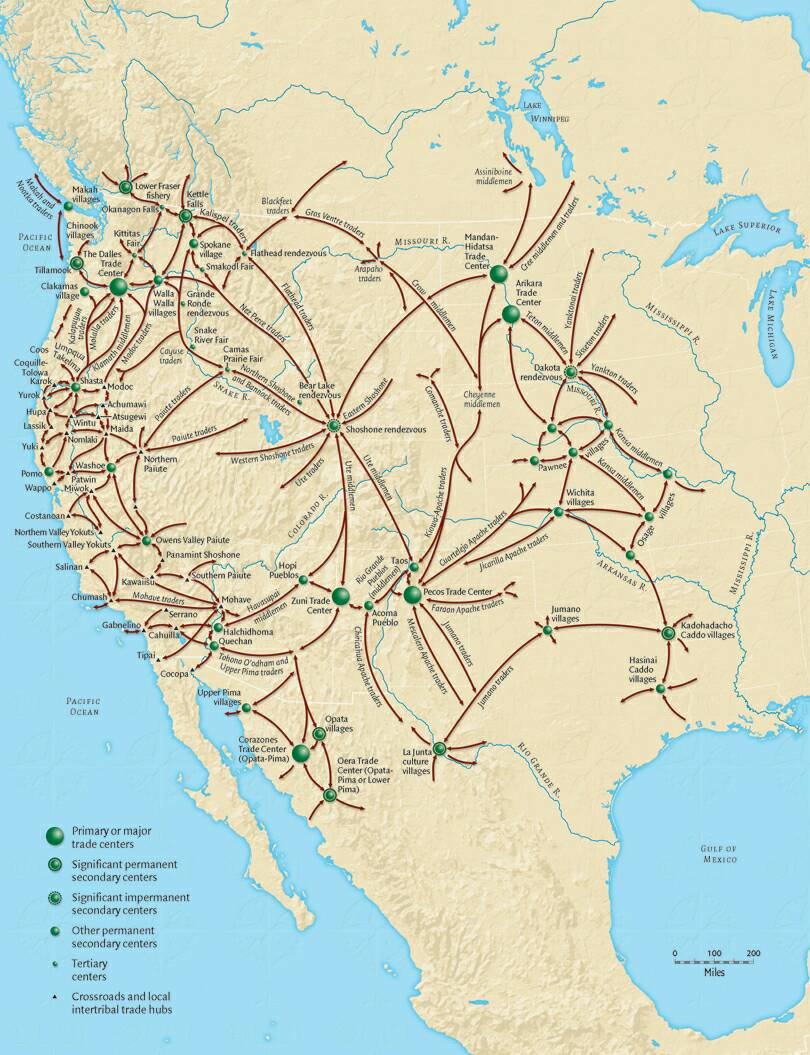
As to trade, I see future reliance on established railroad routes and water routes such as the Mississippi River. I anticipate that, should there be a gradual lessening of Federal power, then there might be more trade within an economic region, and less trade globally and nationally.
As to finance, I see potential reliance on barter, with care not to place our financial assets in overseas locations. Local-employment-based credit unions may come into favor as regional savings repositories.
There may be more reliance on those economic sectors that hold strong during recessions … such as locally grown food, locally obtainable building materials, and water supplies not piped in over long distances.
As to economic stressors, I suggest the overarching stressor of the COVID-19 pandemic, the slowly building economic impact of the HIV pandemic, and stress of regional aridity due to long-distance water transport costs,

A socially disruptive stressor is handheld psychosis, which may lead to chaotic events such as mass murders and actions by public utilities, local law enforcement, and the military regarding perceived dangers that do not truly exist. This might precipitate social unrest, especially in regions of the United States pinpointed by the Jade Helm exercises.
…
2. CAVEATS REGARDING POSSIBLE LOCI OF SOCIAL UNREST top
In United States cities, the high cost of housing and the increasing phenomenon of homelessness may lead to social unrest and attempted land grabs through anarchist behavior; this is something for which, I feel, every large city mayor and every state government ought to have on hand emergency action plans.
For states in arid regions, emergency anti-anarchist plans ought, I feel, to highlight security of water transport systems. Electrical grids, I feel, might also be an anarchist target.
I have a few examples for you, state by state …
In California, I see a rekindling of the Latin American ideal of revolutionary ardor, with possible attempts by undocumented workers … or documented workers fleeing from crimes in their homelands under false names. These energies might, for instance, take the form of faking murders of homeowners under pretense of COVID deaths. The intent might be a fast flip of real estate for profit for a revolutionary cause. Or such an attempt might be made so as to charge revolutionaries rent on homes acquired through COVID murder. Such murders might take place under the aegis of religious righteousness … or what I might term leftwing terrorism.
In others of the United States, there may be similar energies of fake COVID deaths to espouse other causes, such as black militance, white supremacy, and so on.
In Utah, there might be a Mormon separatist energy because of the seditionist history I have read took place with the founder of Mormonism. (I read that in Wikipedia.)
In Florida, there might be attempts on political power by drug lords from countries to the south. And so on.
We people in large United States cities can be a big help in creating peaceful environments for our children by offering our law enforcement departments volunteer help through neighborhood watch programs.
…
3. ON MAINTAINING A POSITIVE ATTITUDE IN THE FACE OF CHANGE top
It seems unlikely to me that anything would happen in a moment; rather I feel that the United States might very slowly tend towards a model of government more akin to the state by state model of our early years as a nation. We may find, in future, that traveling from one state to the next is a refreshingly new experience. Not everyone may be watching the same thing on television every night anymore; there may be less airline flights from here to there; and so the natural flavor and local color of each region of the United States may become more striking to the casual tourist.
In addition, it may be that some regions of the United States may be more perilous (that is, more dangerous) for tourist travel, as was the case for travelers in the early years of our nation.
I realize the prospect of change can be unsettling. It is good to keep in mind that changes such as those spoken of … if, indeed, change there be … would in all likelihood take place by slow stages, over the course of the next century or two. Thus I feel certain there would be plenty of time to make our plans and find our footing in the new.
…
4. POSSIBLE FUTURE UNITED STATES ECONOMIC REGIONS AND TRADE REGIONS top
This section has a series of maps that I have adapted to show possible United States economic regions and trade regions of the centuries that are to come. I would be interested in your comments regarding this intriguing topic of the eventual possibility that the United States government might become less centralized, and more imbued with local flavor and with the strong spirit of our local communities.
HIV-AIDS Pandemic Economic Stressor 1: One Eastern Economic Region Including the Southern States and the Eastern Seaboard
The first map looks like this …
Image: “HIV Pandemic Economic Stressor 1: One Eastern Economic Region Including the Southern States and the Eastern Seaboard,” adapted by Alice B. Clagett, 6 December 2019, CC BY-SA 4.0 … DESCRIPTION: To the right of the white line, One Eastern Economic Region including the Southern states and the Eastern Seaboard … CREDIT: The topographic map is “USA topo en.jpg” [USA Topographical Map], from Wikimedia Commons …
Image: “HIV Pandemic Economic Stressor 1: One Eastern Economic Region Including the Southern States and the Eastern Seaboard,” adapted by Alice B. Clagett, 6 December 2019, CC BY-SA 4.0 …
DESCRIPTION: To the right of the white line, One Eastern Economic Region including the Southern states and the Eastern Seaboard …
You can see a topographical map of the United States that also shows the aridity … the rainfall. States that are green have more rainfall; states that are yellow, less; and states that are red, very little rainfall. Then I have drawn a white line showing an economic region that includes the Eastern Seaboard and the Southern states.
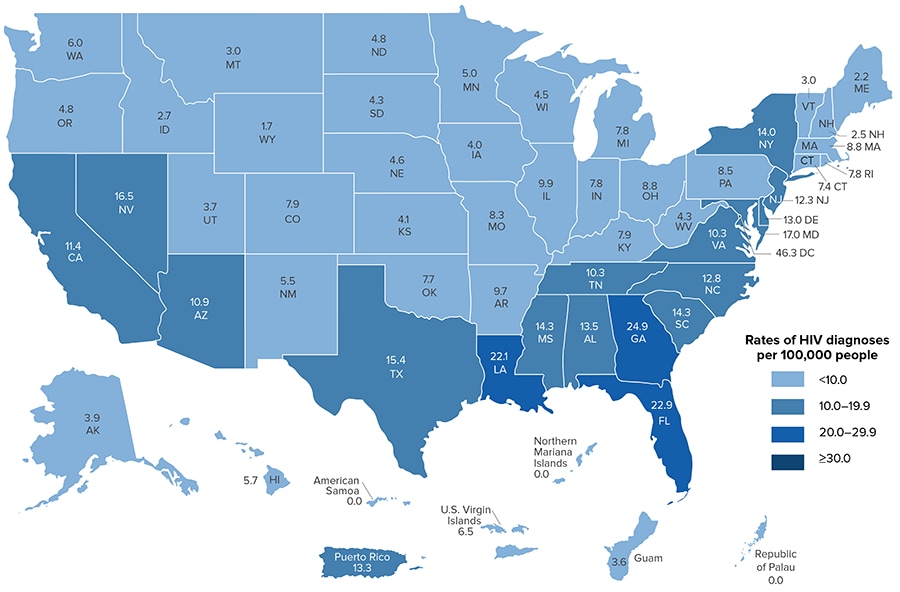
These states are very much affected right now … more so than the other states … by the HIV and AIDS pandemic. And my thought was that that might act as a stressor that would consolidate that group of states into an economic region …
HIV-AIDS Pandemic Economic Stressor 2: An Eastern Seaboard Economic Region and a Southern Economic Region
This map encompasses the same general region as the prior map, but it is divided into two economic regions. To the right is the Eastern Seaboard, and to the bottom left, the Southern states. There is a yellow line between the two economic regions …
Image: “HIV Pandemic Economic Stressor 2: An Eastern Seaboard Economic Region and a Southern Economic Region,” adapted by Alice B. Clagett, 6 December 2019, CC BY-SA 4.0 … DESCRIPTION: To the right of the white line, the earlier Eastern Economic Region divided by the yellow line into two smaller regions: an Eastern Seaboard Region and a Southern Region … CREDIT: The topographic map is “USA topo en.jpg” [USA Topographical Map], from Wikimedia Commons … https://commons.wikimedia.org/wiki/File:USA_topo_en.jpg … CC BY-SA 3.0 Unported
Image: “HIV Pandemic Economic Stressor 2: An Eastern Seaboard Economic Region and a Southern Economic Region,” adapted by Alice B. Clagett, 6 December 2019, CC BY-SA 4.0 …
DESCRIPTION: To the right of the white line, the earlier Eastern Economic Region divided by the yellow line into two smaller regions: an Eastern Seaboard Economic Region and a Southern Economic Region …
So that would be two regions with their own special, local flavor, their own trade agreements; and maybe closely aligned with inter-region trade agreements.
Western Economic and Cultural Stressors: Northwest Economic Region and California Central Valley Economic Region
The below map deals with the West Coast. It shows two economic regions set apart from the rest of the United States with white lines. The upper one is the Northwest Economic Region, and the lower one is the California Central Valley Economic Region …
Image: “Western Economic and Cultural Stressors,” adapted by Alice B. Clagett, 6 December 2019, CC BY-SA 4.0 … DESCRIPTION: Along the Pacific Coast, two regions delineated by white lines. To the north is the Northwest Economic Region, including the parts of Washington state and Oregon with good rainfall. To the South is the California Central Valley Economic Region (also with good rainfall) … CREDIT: The topographic map is “USA topo en.jpg” [USA Topographical Map], from Wikimedia Commons … https://commons.wikimedia.org/wiki/File:USA_topo_en.jpg … CC BY-SA 3.0 Unported
Image: “Western Economic and Cultural Stressors: Northwest Economic Region and California Central Valley Economic Region,” adapted by Alice B. Clagett, 6 December 2019, CC BY-SA 4.0 …
DESCRIPTION: Along the Pacific Coast, two regions delineated by white lines. To the north is the Northwest Economic Region, including the parts of Washington state and Oregon with good rainfall. To the South is the California Central Valley Economic Region (also with good rainfall) …
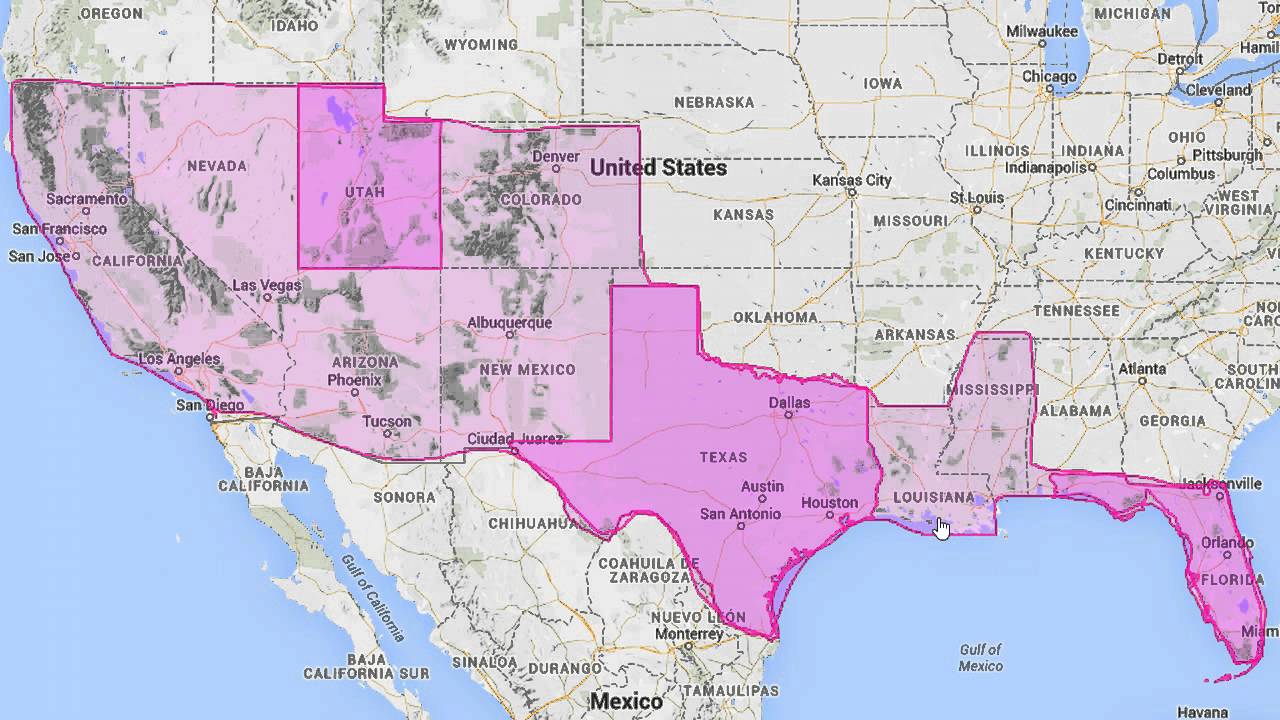
Jade Helm Stressors: A Utah-Colorado Trade Region; a Texas Trade Region; a Mexican Trade Corridor; and a Florida-Caribbean Trade Corridor
This is an interesting map. The Description is below the image …
Image: “Jade Helm Stressors: A Utah-Colorado Trade Region; a Texas Trade Region; a Mexican Trade Corridor; and a Florida-Caribbean Trade Corridor,” adapted by Alice B. Clagett, 6 December 2019, CC BY-SA 4.0 … DESCRIPTION: Circled in yellow are two possible regions that might secede from the Union, but with which reciprocal trade agreements might be negotiated. Topmost is a Utah-Colorado Trade Region (which might be divided into two separate areas based on dominant religion). Lower and to the right is a Texas Trade Region comprising what is now eastern, central, and northern Texas. Then there are two southern regions delineated in white. These are regions that might lean favorably towards alliance with Mexico, but with which we might anticipate establishing reciprocal trade agreements. To the left is a Mexican Trade Corridor comprising California from Los Angeles and to the south; the lower halves of Arizona and New Mexico, and the southwestern part of Texas. To the right is the state of Florida, which might lean favorably toward the Caribbean countries, but with which we might anticipate establishing reciprocal trade agreements; this I term the Florida-Caribbean Trade Corridor … CREDIT: The topographic map is “USA topo en.jpg” [USA Topographical Map], from Wikimedia Commons … https://commons.wikimedia.org/wiki/File:USA_topo_en.jpg … CC BY-SA 3.0 Unported
Image: “Jade Helm Stressors: A Utah-Colorado Trade Region; a Texas Trade Region; a Mexican Trade Corridor; and a Florida-Caribbean Trade Corridor,” adapted by Alice B. Clagett, 6 December 2019, CC BY-SA 4.0 …
DESCRIPTION: Circled in yellow are two possible regions that might secede from the Union, but with which reciprocal trade agreements might be negotiated. Topmost is a Utah-Colorado Trade Region (which might be divided into two separate areas based on dominant religion). Lower and to the right is a Texas Trade Region comprising what is now eastern, central, and northern Texas.
Then there are two southern regions delineated in white. These are regions that might lean favorably towards alliance with Mexico, but with which we might anticipate establishing reciprocal trade agreements.
To the left is a Mexican Trade Corridor comprising California from Los Angeles and to the south; the lower halves of Arizona and New Mexico, and the southwestern part of Texas.
To the right is the state of Florida, which might lean favorably toward the Caribbean countries, but with which we might anticipate establishing reciprocal trade agreements; this I term the Florida-Caribbean Trade Corridor …
As to the Utah-Colorado Trade Region: In Utah, the Mormon faith is very strong. And in Colorado, the Christian faith is very strong. I thought that those two areas of this economic region might pull separately apart, possibly along religious lines.
Southwestern Arid Region: Small Town and Native American Reservation Citadels
This is an interesting map. There is a Description below the image …
Image: “Southwestern Arid Region: Small Town and Native American Reservation Citadels,” adapted by Alice B. Clagett, 6 December 2019, CC BY-SA 4.0 … DESCRIPTION: Circled in white is the large Southwestern Arid Region, which might move to more local forms of small town government … as well as continuing with Native American Reservation governments … should the nation become less centralized. This economic region includes the Great Basin, the Great Rocky Mountains, and the western portion of the Great Plains … CREDIT: The topographic map is “USA topo en.jpg” [USA Topographical Map], from Wikimedia Commons … https://commons.wikimedia.org/wiki/File:USA_topo_en.jpg … CC BY-SA 3.0 Unported
Image: “Southwestern Arid Region: Small Town and Native American Reservation Citadels,” adapted by Alice B. Clagett, 6 December 2019, CC BY-SA 4.0 …
DESCRIPTION: Circled in white is the large Southwestern Arid Region, which might move to more local forms of small town government … as well as continuing with Native American Reservation governments … should the nation become less centralized. This economic region includes the Great Basin, the Great Rocky Mountains, and the western portion of the Great Plains …
This area of the country is very, very arid. One can tell that by the color. I have cordoned off this entire arid zone as an area where Native Americans may establish reservation ‘citadels’ or ‘city towns’ that might act as trading posts for the area, for instance. I consider that they would become more like ‘city states’ if transportation slows down in the United States, and especially in that area, over the centuries.
Central Breadbasket Economic Region
On this map, the area in question is rather green. There is a little yellow, so that part is a little more arid land. It comprises the United States to the west and to the south of the Great Lakes. It includes most of the Mississippi River Valley as well. It looks like this …
Image: “Central Breadbasket Economic Region,” adapted by Alice B. Clagett, 6 December 2019, CC BY-SA 4.0 … DESCRIPTION: Circled in green is a Central Breadbasket Economic Region, with plentiful rainfall and good river transportation. This includes the eastern portion of the Great Plains, as well as the area south of the Great Lakes, west of the Appalachians, and north of the Southernmost states … CREDIT: The topographic map is “USA topo en.jpg” [USA Topographical Map], from Wikimedia Commons … https://commons.wikimedia.org/wiki/File:USA_topo_en.jpg … CC BY-SA 3.0 Unported
Image: “Central Breadbasket Economic Region,” adapted by Alice B. Clagett, 6 December 2019, CC BY-SA 4.0 …
DESCRIPTION: Circled in green is a Central Breadbasket Economic Region, with plentiful rainfall and good river transportation. This includes the eastern portion of the Great Plains, as well as the area south of the Great Lakes, west of the Appalachians, and north of the Southernmost states …
We can anticipate that, if this continues to be a breadbasket area, it could provide food for other economic regions in the United States; and therefore, we would need to maintain some form of transportation to the south and to the east of the Central Breadbasket Region. The question would be whether transportation might be maintained across that vast, arid expanse to the west of the Breadbasket; or whether the Western Seaboard would need to grow its own foodstuffs as transportation became less prevalent.
Possible Future Capital Cities of the United States
Here is the last section, and an interesting one. I have for you three possibilities labeled 0, 1 and 2. The first is Washington, D.C., numbered ‘0’, because that is where the capital of the United States is right now.
Next is Lancaster, Pennsylvania, labeled ‘1’. Long ago, our nation’s capital was Lancaster; so I thought, perhaps one day our capital will be there once more.
And the last is Saint Louis, Missouri, labeled ‘2’. Saint Louis is right in the middle of the Breadbasket. I suggested Saint Louis as the second possibility because the location would be more centralized, and it might pull the other regions together.
Image: “Possible Future Capital Cities of the United States,” adapted by Alice B. Clagett, 6 December 2019, CC BY-SA 4.0 … DESCRIPTION: The current capital of the United States is Washington DC (numbered ‘0’ on the map). Because of the AIDS crisis in Washington DC, and because our nation’s capital was once Lancaster PA, I suggest eventual relocation of the Capital back to Lancaster (numbered ‘1’ on the map). Farther out in time, it may be that Saint Louis, MO (labeled ‘2’) would prove a good location for our nation’s capital … CREDIT: The topographic map is “USA topo en.jpg” [USA Topographical Map], from Wikimedia Commons … https://commons.wikimedia.org/wiki/File:USA_topo_en.jpg … CC BY-SA 3.0 Unported
Image: “Possible Future Capital Cities of the United States,” adapted by Alice B. Clagett, 6 December 2019, CC BY-SA 4.0 …
DESCRIPTION: The current capital of the United States is Washington DC (numbered ‘0’ on the map). Because of the AIDS crisis in Washington DC, and because our nation’s capital was once Lancaster PA, I suggest eventual relocation of the Capital back to Lancaster (numbered ‘1’ on the map). Farther out in time, it may be that Saint Louis, MO (labeled ‘2’) would prove a good location for our nation’s capital …
In the event of decentralization here in the United States, I feel the United States might expect to enjoy three power blocks along geographic lines of the three COVID pacts now in place amongst states in the Eastern States, the Midwest, and the Western States …
The Eastern States Multistate Council to do with COVID consists of the states of Connecticut, Delaware, Massachusetts, New York, New Jersey, Pennsylvania, and Rhode Island …
As well, there is the Midwest Governors Regional Pact” to do with COVID. This consists of the states of Illinois, Indiana, Kentucky, Michigan, Minnesota, Ohio, and Wisconsin …
Here is the map of the power blocks for these pacts, which, I feel, may well be expanded to assure continuity of taxation, mail delivery services, securance of real property rights, and local military defense, in the event of decentralization of the United States …
In love, light and joy
This is Alice B. Clagett.
I Am of the Stars … and so are you!
Blog written and published on 6 December 2019; revised and updated on 2 October 2024; video filmed on 23 February 2022 and published on 26 February 2022 and following
Prior titles: What If the United States Became Less Federal and More Regional in Government? and What If: Will the United States Become Less Centralized?
See also … Link: “Western States Pact and Possible Decentralization of the United States,” by Alice B. Clagett, written and published on 2 June 2020 … https://wp.me/p2Rkym-is3 ..
Image: “United States map of 1861, showing affiliation of states and territories regarding secession from the Union at the start of the American Civil War,” by Júlio Reis, 23 February 2007, from English Wikipedia … https://en.wikipedia.org/wiki/File:US_Secession_map_1861.svg … CC BY-SA 3.0.
Image: “United States map of 1861, showing affiliation of states and territories regarding secession from the Union at the start of the American Civil War,” by Júlio Reis, 23 February 2007, from English Wikimedia … https://en.wikipedia.org/wiki/File:US_Secession_map_1861.svg … CC BY-SA 3.0.
Dust Bowl Economic Stressor
Image: Map of states and counties affected by the Dust Bowl [1930s], sourced from US federal government dept. (NRCS SSRA-RAD).svg … “Based only on that PNG image. I made this file primarily using QGIS, and the following public domain … https://www.census.gov/geo/maps-data/data/tiger-cart-boundary.html shapefiles from census.gov] by Soil Science and Resource Assessment, Resource Assessment Division (NRCS SSRA-RAD) (Division of the U.S. Dept. Of Agriculture), 15 January 2012, from Wikimedia Commons … This work is in the public domain in the United States because it is a work prepared by an officer or employee of the United States Government as part of that person’s official duties under the terms of Title 17, Chapter 1, Section 105 of the US Code.
Image: Map of states and counties affected by the Dust Bowl [1930s], sourced from US federal government dept. (NRCS SSRA-RAD).svg … “Based only on that PNG image. I made this file primarily using QGIS, and the following public domain … https://www.census.gov/geo/maps-data/data/tiger-cart-boundary.html shapefiles from census.gov] by Soil Science and Resource Assessment, Resource Assessment Division (NRCS SSRA-RAD) (Division of the U.S. Dept. Of Agriculture), 15 January 2012, from Wikimedia Commons … This work is in the public domain in the United States because it is a work prepared by an officer or employee of the United States Government as part of that person’s official duties under the terms of Title 17, Chapter 1, Section 105 of the US Code.
Historical Expansion Stressor
Image: “A Map of the United States Showing Land Claims and Cessions from 1782 to 1802,” by Kmusser, in Wikimedia Commons … https://en.wikipedia.org/wiki/State_cessions#/media/File:United_States_land_claims_and_cessions_1782-1802.png … CC BY-SA 2.5 Generic … DESCRIPTION: This is a map showing state land claims and cessions from 1782-1802 that I made. The disputed territory between New Hampshire and New York formed, in 1777, the independent country of ‘New Connecticut’ (later renamed ‘Vermont’) which eventually gained admission as the 14th state in 1791. Boundary disputes between states that were resolved before U.S. independence are not shown.
DESCRIPTION: This is a map showing state land claims and cessions from 1782-1802 that I made. The disputed territory between New Hampshire and New York formed, in 1777, the independent country of ‘New Connecticut’ (later renamed ‘Vermont’) which eventually gained admission as the 14th state in 1791. Boundary disputes between states that were resolved before U.S. independence are not shown.
The above map leaves out Florida, Louisiana, and Mississippi, which were mentioned as being part of the Jade Helm 15 exercise here: “The joint exercise in realistic military training (RMT) known as Jade Helm 15 … was sponsored by the United States Special Operations Command (USSOCOM or SOCOM) … and involved the United States Army Special Operations Command (USASOC) and Joint Special Operations Command (JSOC) with other U.S. Military units in multiple states, including Texas, Arizona, Florida, Louisiana, Mississippi, New Mexico, and Utah.” –from Link: “Jade Helm 15 conspiracy theories,” in Wikipedia … https://en.wikipedia.org/wiki/Jade_Helm_15_conspiracy_theories ..
This map of the Jade Helm exercises includes the states missing in the map above … Link: “Other information (unconfirmed) suggests that Jade Helm is geographically larger (10 states), involves larger forces and has already started,” in Citizens Journal … https://www.citizensjournal.us/wp-content/uploads/2015/05/jadehelmother.jpg ..
Nuclear Power Plants and Seismic (Earthquake) Safety Survival Factor
Image: “Map prepared for CRS report for Congress: Andrews, Anthony, 2011 ‘Nuclear power plant design and seismic safety considerations’ Library of Congress Congressional Research Service report R41805, May 2, 2011, Washington. p. 22, fig. 8.” Available also through the Library of Congress Web site as a raster image. Includes list of nuclear reactors with statistics. 2011. Source: https://www.loc.gov/item/2011594649/ … from Wikimedia Commons … https://commons.wikimedia.org/wiki/File:Operating_nuclear_power_plant_sites_vs._seismic_hazards_in_terms_of_percent_gravitational_acceleration_-_(United_States)_LOC_2011594649.jpg …. This work is in the public domain in the United States because it is a work prepared by an officer or employee of the United States Government as part of that person’s official duties under the terms of Title 17, Chapter 1, Section 105 of the US Code.
Image: “Map prepared for CRS report for Congress: Andrews, Anthony, 2011 ‘Nuclear power plant design and seismic safety considerations’ Library of Congress Congressional Research Service report R41805, May 2, 2011, Washington. p. 22, fig. 8.” Available also through the Library of Congress Web site as a raster image. Includes list of nuclear reactors with statistics. 2011. Source: https://www.loc.gov/item/2011594649/ … from Wikimedia Commons … https://commons.wikimedia.org/wiki/File:Operating_nuclear_power_plant_sites_vs._seismic_hazards_in_terms_of_percent_gravitational_acceleration_-_(United_States)_LOC_2011594649.jpg …. This work is in the public domain in the United States because it is a work prepared by an officer or employee of the United States Government as part of that person’s official duties under the terms of Title 17, Chapter 1, Section 105 of the US Code.
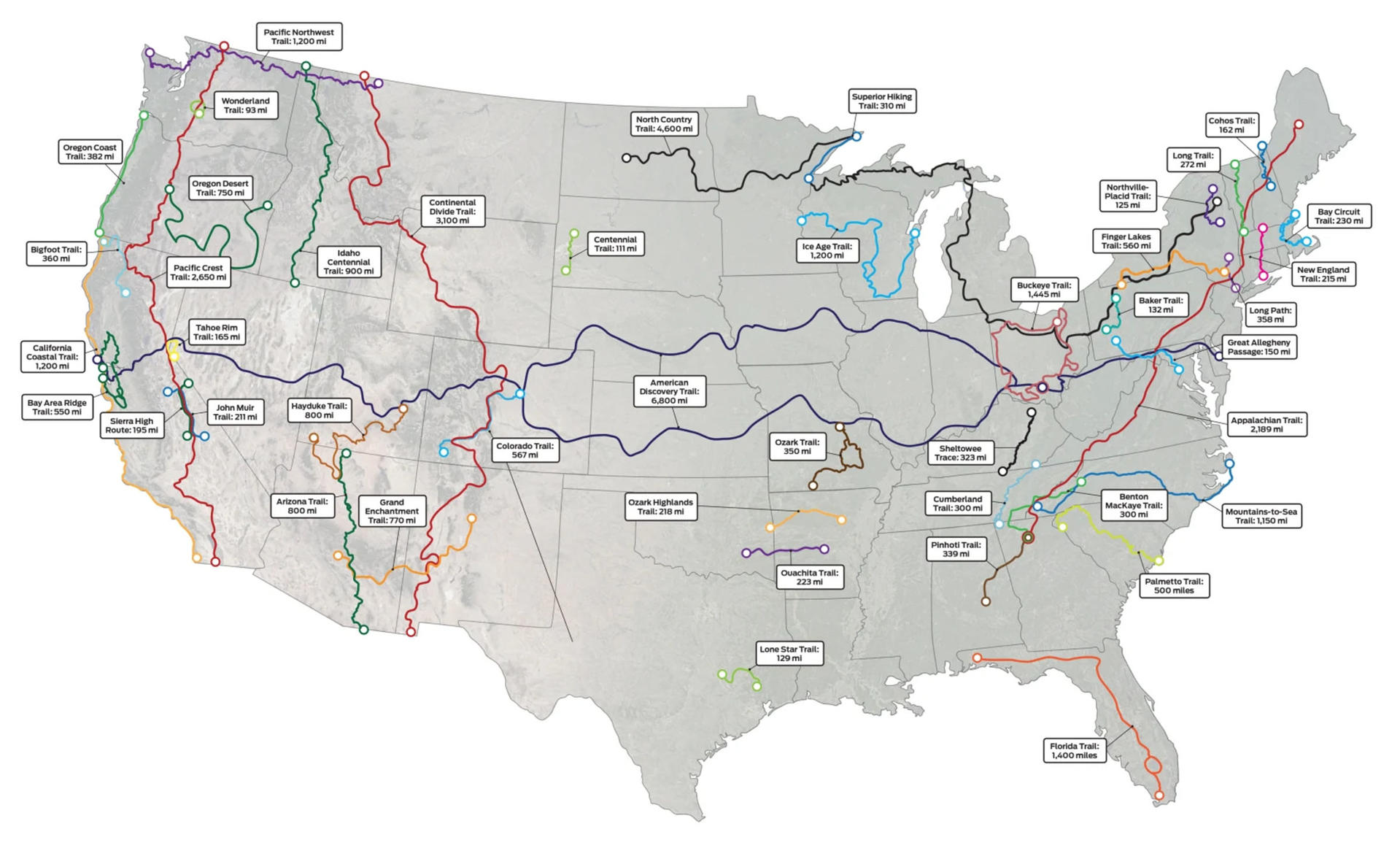
My feeling is, these hiking trails might provide alternative transportation routes if highways are blocked due to natural disasters or highway repair issues …
Image: “This is a map of the Class I Railroads I made using DOT data,” by Kmusser, 9 August 2006, in Wikimedia Commons. This file is licensed under the Creative Commons Attribution-Share Alike 2.5 Generic license.
Image: “This is a map of the Class I Railroads I made using DOT data,” by Kmusser, 9 August 2006, in Wikimedia Commons. This file is licensed under the Creative Commons Attribution-Share Alike 2.5 Generic license.
…
6.4 CAVEATS FOR UNITED STATES DOMESTIC TOURISTS top
It may become more difficult to travel from state to state; this may have to do with lack of availability of gasoline, or lack of availability of charging stations for electric cars.
United States tourists may find it less safe to travel to other states. Their lives may even be imperiled while staying in some small towns that are distant from their own residences.
There may be tampering on a local basis with criminal databases, combined with identity theft and synthetic identity fraud, so that a tourist to a small town in a distant state is fraudulently classed as a criminal, and then subjected to local laws whose flavor and whose meeting of criminal punishment differs greatly from those in the tourist’s home town.
For instance, in the visited town euthanasia of senior citizens might be legal. The ‘captured’ tourist might be legally executed on a charge of senile dementia or Alzheimer’s disease. That charge could be made to stick through unrelated, criminal local people swearing on oath that the person is their spouse, swearing that the age is elderly, stating that the person has no money or means of earning it. Then the tourist might be killed and his or her money divvied up amongst the judge and the perjuring criminal.
Other instances: Blue laws and the penalties for child molestation, and the enforcement of these laws differ greatly from state to state. It is easy to assume that what ‘flies’ in one’s own state will ‘fly’ in the tourist town. Then, quick as a whip, a person might find himself behind bars and far from home, and subject to whatever local scam will fleece him of his money.
Another instance: Drug possession laws differ greatly from state to state. The scenario is the same as for Blue laws.
Drug lords may be in possession of the town, as was the case with Baltimore, Maryland, in recent years. If so, anything goes. Best not to set foot there. It is possible that local law enforcement and local court systems in towns ‘captured’ by drug lords might function in ways unexpected by a tourist, because of the threat of death for themselves and their families, and also because of financial inducements by drug lords. In other words, the tourist’s life might be worth a nickel. Maybe less.
A local tradition of bribery of officials is a consideration for tourists. This horse kicks two ways: You might be jailed if you do not bribe; or you might be fined for attempting to bribe. I am at a loss for words here.
Other instances: Homelessness may be considered a cause for euthanasia without court trial. This stance might be set in place by barring a tourist from local motels and hotels, then accosting him or her while asleep in their car.
Suppose a local gas fill-up were to result in a car breakdown 10 miles away, say, in the desert. Suppose the gas station owner had a group of related men who went out to scavenge vehicle parts, wallet and credit cards of the stranded car owner, and leave his bones beneath a Joshua tree.
[In terms of unexpected services rendered, I have encountered a case a little like that here in Los Angeles, where an acupuncturist demanded to see the drivers license after treatment, as a prerequisite to payment for services rendered. I intuited that the health care practitioner has an expensive addiction, and had been sending round family members to the addresses on the drivers licenses of her clients to burglarize the homes to help finance her habit. To prevent the victims from returning … in other words, to ensure a fresh group of people to be burgled … the acupuncturist set the electric needle settings too high, so that her clients received muscle-stunning electric shocks from the needles.]
The tourist’s sanity may be placed in doubt through false testimony by local mail-order psychologists also claiming at the local police station to be the ‘spouse’. This may be a game with many innings.
I intuit that local sheriffs and judges place more weight on testimony of their friends and neighbors than they do on the testimony of strangers. Where you visit, if you travel alone, may have crime gangs that, in cahoots with a sheriff or law enforcement officer, railroading tourists with intent to gain more tourist dollars. This may be more likely in low per capita towns.
There may be a local tradition of kangaroo courts that convict a tourist of this or that without his or her presence in the courtroom. There may be other legal irregularities, such as a crooked judge who holds a kangaroo court session on a Sunday, with written judgment conveyed, but with no online record of a court case. The kangaroo court paper of the crooked judge might be used to ‘capture’ and shake down the tourist. There is a danger of legal murder by euthanasia after the shake down, so as to prevent the tourist from taking legal action against the offending parties after changing the venue to their own home town.
In other words, the law may not be on your side, or it may not take the stance you expect it to take, when you travel to another state. This may become increasingly true with time, that towns in states other than one’s own may prove lethally unfriendly to tourists.
…
6.4 NEWS THAT SUPPORTS THE THEORY OF A RETURN TO LIBERTARIANISM top
I may be adding to this category as I run across news articles.
United States, government, economics, history, geography, politics, social unrest, Jade Helm, community health, HIV pandemic, AIDS pandemic, homelessness, handheld psychosis, my favorites, future, COVID-19, coronavirus, Libertarianism, democracy, trade, finance, economy, transportation,
Libertarianism, government, U.S. Government, United States government, United States, economy, economics, taxes, IRS, U.S. Post Office, communications, internal revenue service, decentralization,
United States, economy, economics, government, U.S. Government, United States government, decentralization, regionalism, Libertarianism, democracy, libertarianism, military, social security, foreign affairs, trade, transportation, finance, credit unions, handheld psychosis, law enforcement, public utilities, mass murder, social unrest, cognitive dysfunction, discernment,
social unrest, United States, housing, real estate, homelessness, government, state governments, city governments, water transport, utilities, electric utilities, anarchy, California, Utah, Florida, sedition, anarchy, murder, COVID, terrorism, leftwing terrorism, rightwing terrorism, racial tensions, cultural tensions, drug war, neighborhood watch, law enforcement, secret service,
United States, government, libertarianism, state governments, tourism, decentralization,
United States, government, libertarianism, state governments, trade, transportation, decentralization, trade agreements, Southern states, Eastern Seaboard, Western Seaboard, Mexican border, Native Americans, AIDS, HIV, Breadbasket, foodstuffs, agriculture,
It looks to me like the prevalences (aka ‘risk’) below should have been per 100,000 people. That would make the statistics far lower. I say that because of this recent article …
How Family Wealth Planning for Future Generations Is Affected by HIV Prevalence
How May We Instill Hope in Our Families, Even Though They May Have HIV?
Careers Despite HIV
Continuing to Work Despite Blindness
RECENT CDC FIGURES ON HIV LIFETIME RISK
Table 1. Lifetime Risk of HIV Diagnosis, by Sex, Race/Ethnicity, and Risk Group, United States
Gender Inequality in Testing for HIV – AIDS
Lifetime Risk for Black Men Who Have Sex with Men
Table 2. Lifetime Risk of HIV Diagnosis, by State, United States
Great Disparity in Lifetime Risk, State by State
Possible Underreporting of Risk by States for Economic Reasons
Risk in Large Cities
Table 3. 10-Year Age-Conditional Risk (1 in n) of HIV Diagnosis Among HIV-Free Males and Females, Aged 20-50 Years, United States
Young Men Who Have Sex with Men Are at Greater Risk of New HIV Diagnosis
New HIV Diagnosis Risk for Young Men Who Have Sex with Men Varies Greatly by Race / Ethnicity
New HIV Diagnosis Risk for People Who Inject Drugs is Much Less Than for Men Who Have Sex with Men
New HIV Diagnosis Risk for Young Women Who Inject Drugs Is Twice as Great as for Young Men
Can We Extrapolate That HIV Diagnosis Risk for Young Women is Twice as Great as That for Young Men?
Importance of Gender Equality in HIV / AIDS Testing of Young People
Dear Ones,
MISLEADING NATURE OF CDC HIV DATA
Over the years I have written quite a few blogs on the HIV / AIDS global pandemic. Chicken that I am, I feel I have failed to convey my feeling that the Centers for Disease Control (CDC) is releasing data about the pandemic that greatly misrepresent the difficulties that lie before us as a nation. Perhaps this misrepresentation is intentional; perhaps it is political in nature … and perhaps not. Who can say?
The crux of the matter is that the data the CDC typically presents to the public have to do with disease ‘incidence’ rather than disease ‘prevalence’ or ‘lifetime risk’.
‘INCIDENCE’ of HIV / AIDS
As I understand it, disease ‘incidence’ has to do with how many new cases will be diagnosed next year, or the following year. These data are important to medical doctors, so that they can have sufficient medications on hand for the coming year.
‘PREVALENCE’ or ‘LIFETIME RISK’ of HIV / AIDS
‘Prevalence’, or ‘lifetime risk’ offers data on the likelihood that we and our families will contract HIV / AIDS during our lifetime. These are the data that I feel are hard to find in the CDC documents. Yet these are the data that help us plan for our families’ future.
How Family Wealth Planning for Future Generations Is Affected by HIV Prevalence
For instance, if our children, according to ‘lifetime risk’ data, are likely to contract HIV / AIDS in their lifetime, then we might ask: At what age are they likely to contract the disease?
If they contract it in early childhood, from what I have read, it is apparently likely they will die from it at a young age.
If they contract the disease at about the age of puberty, from what I have read, it is likely they will be unable to bear offspring that live more than a few years.
If our children contract the disease while their children are young, then apparently the risk is high that their young children will contract the disease from their parents through suckling milk, or transmission of bodily fluids while the family has bouts of cold or flu, or through childhood play.
Whether or not our children will contract the disease before they bear children is, I feel, very important to each family’s planning for the future. If there are no grandchildren, then that will make a big difference in the wealth that must be set aside for future generations. In addition, health care costs and the economic impact of sick leave downtime for our infected children and grandchildren is a wealth planning consideration.
How May We Instill Hope in Our Families, Even Though They May Have HIV?
If the lifetime risk of contracting HIV / AIDS is high, either because of lifestyle choices, or because of race or ethnicity, or because of the city or state or region of the United States in which we live, then now would be the time to plan with our children and grandchildren for a future that may involve infection.
Our families need to have some hope to live for, even though they may be infected.
I will say that, in my opinion, the CDC does a great job of glossing over the downside, and providing the upside of life with HIV / AIDS. So families can go to their site to learn that life with HIV is no big deal in the United States, any more.
By that is meant, I feel, that for those who are able to tolerate the drug regimens that have been developed, the prospect of a long and productive life is good. And that is something that might offer hope to our children: They may find that they, or their friends, contract the disease.
Careers Despite HIV. Maybe they may not be able to have families of their own, but they can look forward to fulfilling careers, and maybe good health for quite a long time.
Continuing to Work Despite Blindness. I note that, as of 2001 10-20% of people worldwide who had AIDS were becoming blind in one or both eyes …
Thus, as a nation, we must retool as many industries as possible so that our eyesight-impaired HIV-positive children can continue on with their careers even should they have low vision.
RECENT CDC FIGURES ON HIV LIFETIME RISK
Today I found a pretty good pdf file offered by the CDC, that presents lifetime risk and also age-conditional risk by race and ethnicity, gender, and state. The data are from 2009-2013 …
Link: “Lifetime Risk of a Diagnosis of HIV Infection in the United States,” by Kristen L. Hess, PhD, MPH, Xiaohong Hu, MS, Amy Lansky, PhD, MPH, Jonathan Mermin, MD, and H. Irene Hall, PhD, MPH, HHS Public Access Author Manuscript, Ann. Epidemiol. published in final edited form as: Ann Epidemiol. 2017 April ; 27(4): 238-243, doi:10.1016/j.annepidem.2017.02.003 … https://www.ncbi.nlm.nih.gov/pmc/articles/PMC5524204/ ..
By clicking on the above pdf link you can download the document to your computer.
Of special note are the three tables at the end of the document.
Table 1. Lifetime Risk of HIV Diagnosis, by Sex, Race/Ethnicity, and Risk Group, United States
Gender Inequality in Testing for HIV / AIDS. I note the total lifetime risk for men is 1 in 68 people, and for women 1 in 253 people. I believe this has to do with gender inequality in testing for HIV / AIDS. I feel the perception in the medical community is that MSM men are at risk for HIV / AIDS, and so, I feel, doctors are more likely to test men than women.
As I have mentioned priorly, it could be that bisexual men who are dating or married to women and raising families are also at risk, and that their wives and families are at risk and fail to test for HIV – AIDS because they are uninformed about their boyfriends’ or husbands’ exposure to risk.
I would like to see equal gender testing for HIV / AIDS, especially among couples with children where the boyfriend or husband tests positive for HIV. Then the medical community might, a few years from now, reassess the total lifetime risk for women.
Lifetime Risk for Black Men Who Have Sex with Men. I note the lifetime risk of contracting HIV / AIDS is 1 in 2 men. The overall lifetime risk for men who have sex with men is 1 in 6 men. From this I feel that women who want to have families ought to ascertain, before becoming pregnant, whether the prospective fathers in fact prefer to have sex with men. I feel that societal expectations, especially amongst Christians, make it especially difficult for Christian men to disclose this bias to prospective wives.
Given this, I feel all women hoping to have children ask those men they want to be intimate with for HIV test results, keeping in mind that chastity for one month after the last sexual contact is necessary before tests such as Oraquick can provide relatively accurate results. The last I read in the fine print of the Oraquick package was that there was a 10 percent error in this type of saliva test. HIV blood tests, while more expensive, are a good deal more accurate; they are the best the medical community can offer presently.
Table 2. Lifetime Risk of HIV Diagnosis, by State, United States
From this table, I note a big range of risks, state by state, and in the District of Columbia.
Great Disparity in Lifetime Risk, State by State. For instance, the lifetime risk in Maryland is 1 in 56 people. But the risk in Montana is 1 in 674 people. The other states are in between these two extremes, with Georgia and Florida on the very risky side, and Idaho and North Dakota on the ‘unrisky’ side.
The first thought along these lines, for families who are concerned about HIV infection, might be (and I agree it seems logical) to relocate to a state that has less lifetime risk of infection.
Possible Underreporting of Risk by States for Economic Reasons. Amongst the states, I feel it likely that there may be HIV / AIDS ‘underreporting’, and that this may have to do with the tourist trade, or perceived need to attract new business to one’s home state. If this is true, I hope lifetime risk reporting will become more accurate in the next few years, as our states owe it to their residents to offer accurate figures, so that families can take steps for disease prevention and health care.
Risk in Large Cities. I note the lifetime risk of HIV / AIDS is 1 in 17 people in the District of Columbia, which is the heart of one of our large metropolitan areas. In past blogs, I have asked for a breakdown of lifetime risk for our large cities, as the very high risk in the District of Columbia may in fact indicate high risk in other large United States cities as well.
Table 3. 10-Year Age-Conditional Risk (1 in n) of HIV Diagnosis Among HIV-Free Males and Females, Aged 20-50 Years, United States
Young Men Who Have Sex with Men Are at Greater Risk of New HIV Diagnosis. From these data I see that overall, it is four times more likely that men who have sex with men, and who are 20 years of age will get a new diagnosis of HIV than will men who have sex with men, and who are 50 years of age.
New HIV Diagnosis Risk for Young Men Who Have Sex with Men Varies Greatly by Race / Ethnicity. For black men who have sex with men, the risk of new diagnosis of HIV is 1 in 4 at age 20 and 1 in 26 at age 50. For Hispanic men who have sex with men, the figures are 1 in 13 at age 20, and 1 in 40 at age 50. For White men who have sex with men, the figures are 1 in 39 at age 20 and 1 in 79 at age 50.
New HIV Diagnosis Risk for People Who Inject Drugs is Much Less Than for Men Who Have Sex with Men. Also, I see that people who inject drugs and are 20 years of age are somewhat less likely to get a new diagnosis of HIV than people who are 50 years of age; and that the overall new diagnosis risk for people who inject drugs is, across the age spectrum, very much less than for men who have sex with men.
New HIV Diagnosis Risk for Young Women Who Inject Drugs Is Twice as Great as for Young Men. Overall, for men who inject drugs the new diagnosis risk is 1 in 220 at age 20, and 1 in 167 at age 50. For women who inject drugs the new diagnosis risk is 1 in 108 at age 20 and 1 in 112 at age 50. That would mean that amongst people who inject drugs, women 20 years of age are about twice as likely to get a new HIV diagnosis as are men that age.
Can We Extrapolate That HIV Diagnosis Risk for Young Women is Twice as Great as That for Young Men? As both men and women who inject drugs know they are at risk, it seems to me fair to assume they are testing for HIV in a gender equal way. Thus the figures for new diagnosis risk for men and women who inject drugs might help provide an answer regarding the true new diagnosis risk for women who fail to test because they do not know their boyfriends or husbands are having sex with men.
We might go with the assumption that women who are dating or married to men who have sex with men have twice as much risk of new HIV diagnosis as the men. Amongst 20-year-old men having sex with men the new diagnosis risk is 1 in 15. Projecting from the drug injection risk, 20-year-old women who have sex with men who also have sex with men might be expected to have a new diagnosis risk of 1 in 8 (twice as risky as for the men).
I arrive at this estimate by creating a similar ratio, like this …
New diagnosis risk at 20 for men versus women who inject drugs = 1/220 for men versus 1 in 109 for women (about twice as risky for women)
Extrapolating new diagnosis risk at 20 for men versus women in relationships where the man has sex with men = 1 in 15 for men versus 1 in 8 (about twice as risky) for women
Importance of Gender Equality in HIV / AIDS Testing of Young People. The above estimate highlights how important gender equality in HIV / AIDS testing may be right now, as regards testing for young women.
From the above estimate we might also extrapolate the number of men who are not disclosing their bisexual lifestyle. If in fact it proves true that twice as many young women as young men, overall, are getting new HIV diagnoses, then it seems to me possible that as many as half of American men are engaging in sex with men as well as with their female sexual partners and wives.
What otherwise would account for young women having a higher incidence of new diagnoses than young men? I have read online that many young women have sex with two men by about age 20. If one of these two had HIV, and gave it to the young woman, then her new male partner would be at risk of infection as well. If this were to be so, then the risk for young women might be from young men who also have sex with men. And the risk for young men might be from having sex with either young men who have sex with men, or from having sex with young women who have done so. Do you not feel this to be true?
If so, then the feat that lies before the medical profession would be to find the most effective way of gathering information from young HIV positive men regarding their female sexual partners, and of persuading the men to allow their female sexual partners to test.
Blessings to all,
In love, light and joy
This is Alice B. Clagett.
I Am of the Stars … and so are you!
politics, Centers for Disease Control, CDC, HIV, AIDS, community health, United States, health, HIV pandemic, health, Western medicine, abundance, prosperity, careers, child-rearing, social issues,
My feeling is, in future the United States ought to offer foreigners the same opportunity to work, and own homes, as is the case for United States citizens in the corresponding foreign countries.
In other words, for instance, if United States citizens were to be able to own land in Mexico; and if we were to be able to find employment in Mexico, then let us provide employment and property ownership for Mexican peoples who are here in Los Angeles. And we might offer the same trade with other countries.
In that way we might acquire for our citizens more rights in foreign lands.
In love, light and joy
This is Alice B. Clagett.
I Am of the Stars … and so are you!
Any stories or events described in this site are entirely fictional and the characters referred to are entirely fictional as well, except where a story or event is referred to in a patently factual context, or where a person is referred to by name in a patently factual context.


.svg)



_LOC_2011594649.jpg)